
About Slip Stroke
~ Slip Stroke in Pool: A Unique Grip Technique Inspired by Martial Arts ~
Hello!
My name is "Cocoro."
The name comes from the Japanese word "心" (kokoro), which means "heart" or "mind."
I'm a pool enthusiast.
On this page, I would like to share the slip stroke, a technique I have been diligently practicing for about 15 years and have finally mastered. Recently, it has become more commonly known as the slide stroke.
There is only one thing I focus on in pool: improving my ability to pocket shots, no matter how difficult they are. That has been my singular pursuit—whether it's a challenging shot, a ball near the rail, a long shot, or a delicate cut.
"I don't care. I'll pocket it."
I have been studying strokes with this sole purpose in mind, in search of "my unique stroke." But what I strive for is the ultimate stroke.
This journey of exploration is likely to continue, but I hope my experience will be of some help to you.
“This page contains promotional content.”
Conclusion of the Slip Stroke
Stroke only from the elbow down
Slide the cue at the moment of impact
The cue ball and the moment of sliding the cue,
The distance between the cue and the tip is 1mm (ideal)
The cue ball and the tip touch,
The timing of impact is important
Use a special grip shape
Demerits can be overcome
Only merits can be extracted
Method of Cocoro's Stroke
Hold the cue with the middle finger slightly off the cue
Use only the ring finger to prepare the stroke
At the moment of impact,
Simultaneously with the slip stroke,
Release the index finger
This completes the motion
That's it.
Below, I will describe the details based on my experience and the information I have researched.
I am currently using a stroke called the slip stroke (or slide stroke) with a particular grip.
What is a Slip Stroke?
Among modern players, this is the stroke used by Ignacio. You can probably find videos by searching "Billiards Ignacio Slip Stroke" on YouTube. I’ve been using it for a long time, ever since I read an article in a billiards magazine called "Cue's" about 20 years ago. The article featured a player named Billy Joe Purge (if I remember the name correctly), who used this stroke to make many successful shots. Since then, I’ve been studying strokes continuously.
As the name "slip stroke" suggests, this stroke involves sliding the cue forward. It takes advantage of the cue's natural forward inertia. Imagine oiling the grip area and taking a powerful shot—the cue would slip out of your hand and move forward. That’s essentially what this stroke replicates. To explain more technically, it minimizes the friction between your grip and the cue, allowing only the cue to move forward. Put simply, it’s about releasing the cue at the moment the tip contacts the ball and letting it slide forward.
The basic motion of this stroke involves keeping the elbow at a fixed height and stroking like a pendulum, using the elbow as the pivot point. You make the stroke without involving your shoulder or dropping your elbow. Although it’s possible to follow through using your shoulder with the slip stroke, I prefer to use only from the elbow down. When I use my shoulder, my timing tends to shift at the moment of impact, which leads to missed shots. For example, think of a snooker stroke. Because snooker pockets are narrower and harder to make shots in, players developed a specific form and stroke style designed for consistent pocketing. That's why I adopted this method in my own stroke as well.
If you search for "Snooker O'Sullivan" on YouTube, you'll find videos of snooker matches.
(I personally love watching O'Sullivan—he can pocket anything, lol)
He makes brilliant clearances that make a 147 (maximum break) look effortless. In snooker, there's a distinctive stroke style that includes a pause during the backswing. However, with the slip stroke, I find it's easier to maintain timing and stabilize my shots if I swing smoothly without pausing. (This is just based on my personal experience.)
When playing a follow shot (push), I sometimes lower my shoulder and think, “Let’s push it!” But I’ve found that if I drive through the upper impact point using only the motion from the elbow down—without lowering my shoulder—I make fewer mistakes. Because of the nature of the slip stroke, however, it's difficult to hit a ball that doesn’t “crack” or to strike a heavy ball effectively.
I believe that truly shooting a ball with solid speed and mass energy means delivering the cue’s weight and motion energy directly and parallel through the center of the cue ball, in the direction of its path. For now, I’ll temporarily refer to a ball that carries this kind of forward-driving speed and mass energy as a “heavy ball.” But when you need to shoot a heavy ball, aim for a point close to the center of the ball and try to make contact as closely as possible to the moment the cue tip and ball meet. You can also shoot a heavy ball by slipping. Because the cue slips the moment the tip touches the ball, the timing when the spin grips the ball is critical... But if you can feel the moment when the tip and cue ball touch, you can somehow shoot a heavy ball. The same principle applies for up, middle, down, left, and right shots.
Drawbacks of the Slip Stroke
The cue ball tends to feel light overall.
The timing of the impact can be unclear.
Depending on the timing, it's easy to make a shooting mistake.
The amount of spin can be inconsistent.
You may feel uneasy at the moment of impac
(Because only the cue moves forward)
It’s difficult to shoot with power.
Long shots tend to lack spin.
It takes a knack to hit weak shots well.
The amount of draw (pull) needs to be adjusted carefully.
Conversely,
Benefits of the Slip Stroke
Straight shots almost always go in.
Shot success rate improves
(though it varies by individual)
Spin is easy to apply.
It’s easy to pot various types of shots.
Bank shots become easier to make.
The stroke looks clean and elegant.
You can use the cue’s natural inertia.
You can harness the cue’s raw power.
The twist of the cue feels sharp and crisp.
These are the advantages of the slip stroke.
The disadvantages can be overcome with practice and effort, so once you get used to it, this stroke can be very effective.
"The moment when the cue tip touches the cue ball — timing is everything."
The timing is very important, and it’s a delicate balance, but it becomes easier once you get the hang of it. Because of the precise timing, when I first started, if the impact was off even slightly, my shots would go horribly wrong. Since changing my grip, the probability of missed shots has dramatically decreased. One important point to note during the impact of the slip stroke is that if you slip "too early," meaning before the cue ball and tip make contact, the shot is more likely to go off target. I haven’t measured it exactly, so this is just my feeling, but if you start slipping about 5 cm to 10 cm before the cue ball and tip touch, the chances of missing the shot increase. As for the timing of the slip, I think it’s acceptable to start slipping just before the 5mm to 1cm range. It’s like slipping when the elbow is around a 90-degree angle. Therefore, during the preparatory strokes, it is best to keep the cue ball and the tip of the cue as close as possible.
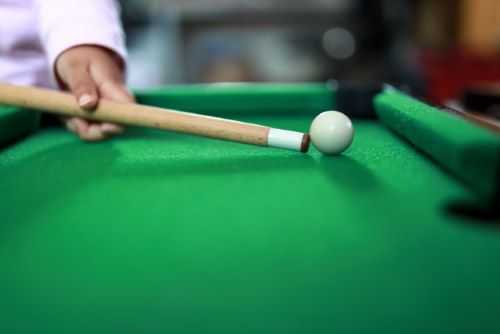
In my experience, when I was under pressure, I would slip at an "overly early timing" of impact, causing me to miss an otherwise easy shot. This "overly early timing" is about 5cm to 10cm before impact, based on my perception. However, slipping at an "overly late timing" doesn't work either. If you slip after the impact is completely over, you won’t be able to fully utilize the characteristics of the slip stroke. The cue's forward inertia will be gone, and it won't be in a slipping state anymore. Similar to the "before" impact, the "after" impact is probably within a tolerance of about 5mm to 1cm.
The moment before impact → At the moment of 1mm to 3mm, or when the "cue ball and tip touch," it’s better to slip because the spin will "ride." So, I think it’s easier to time the impact about 1mm to 3mm before the impact. The ultimate ideal moment is the instant within 1mm of contact. The 1mm distance is not something I measured precisely — it is based on my own feeling. With the feeling of "applying spin" at that 1mm distance, if you slip while applying spin, the shot will capture the impact point precisely. In other words, it becomes a shot that "carries the ball." It’s like applying spin while the tip of the cue compresses by 1mm.
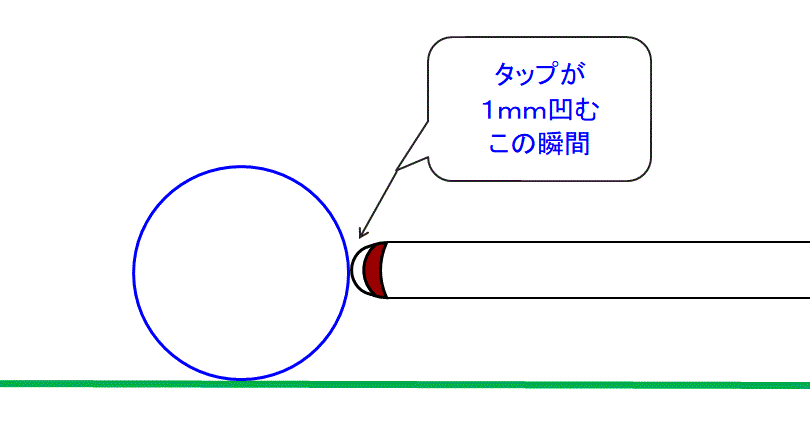
This sensation of "biting the rotation" happens when the timing of biting the rotation at the moment of impact aligns perfectly. I feel that this results in a shot that shoots the impact point firmly = "carrying the ball." In the slip stroke, the timing of the touch is critical and it takes practice to "bite the rotation." But when the timing aligns perfectly and you can strike, it’s incredibly satisfying with a beautiful twist.
I also practiced closing my eyes to feel the moment of impact and internalize the timing.
- ・ Speed of slow shot
- ・ Speed of normal shot
- ・ Speed of hard shot
Practicing at different cue speeds with your eyes closed is a great way to memorize the timing.
(Of course, during this practice, it's not a slip stroke but a normal stroke where you can feel the moment of impact.)
When you instinctively understand the perfect timing of "Here!!", executing a slip stroke becomes significantly easier.
You can also sense the impact through the sound of the cue. At the same time, since you can make the cue ball contact the first ball while retaining spin, the accuracy of long shots also improves.
Even when performing a draw shot, if you grasp the timing of contact, it becomes easy to execute. If you lightly slide the cue at the moment of contact, the ball will naturally draw, making the shot easier.
(In the case of a draw shot, the moment of touch is especially crucial.)
The distance and degree of the draw can be a bit vague based on the amount of spin, so I recommend adjusting the distance by focusing on the impact point and the timing of the slip. One thing to be careful about when sliding in a draw shot is that if you loosen your grip too much at the moment of impact, the impact point may shift, or the direction of the cue may change, which can easily lead to a missed shot.
Now, here’s a tip for shooting softly (slow shots). When shooting softly, if you stroke forward "slowly..." and lightly slip at the moment when the tip touches the cue ball (about 1cm to 2cm before contact), you can surprisingly make a stable shot even when shooting slowly.
While it’s possible to use normal timing, slipping during a full swing often results in too much momentum, making soft shots difficult. With a slip stroke, slow shots become more challenging in reverse.
(Is it a timing issue? Either way, I had many shooting mistakes.)
The distance the cue slides within your grip depends on how much force you want to apply to the shot. As long as the shot is successful and you can position the next ball where you want, the sliding distance is not an issue.
From my own physical experience, sometimes I slide the cue about 10cm in the grip, sometimes 5cm, sometimes 3cm, sometimes 1cm, sometimes 5mm... It varies. If the "moment of impact" is correct, I don’t think you need to worry too much about how far you slide the cue in the grip.
When aiming for a soft shot,
"The timing when the rotation (spin) comes off"
Please be careful here.
Hitting the center of the cue ball with a slip stroke is quite difficult. (At least, that’s my experience.)
Inevitably, a slight twist in the up, down, left, or right direction will occur.
Due to friction with the cloth, an unintended spin may be applied to the cue ball right when the initial spin wears off.
This can affect the first ball and lead to a missed shot. It feels like a light skid.
Is this related to the cause of a skid?
I'm not fully sure about the physical phenomena here, but it feels that way.
If you're going to use a spin, use it. If you're not going to use it, don’t use it, and it's better to clearly distinguish between the two for a stable shot.
This might apply to any stroke, but it's essential to avoid lifting your head until you’ve fully "shot through" the cue ball.
Image of Slip Stroke
- Tip of the cue touches the cue ball
- ↓
- Slip at the moment of impact
- ↓
- Push out the cue ball
- ↓
- End of shot
This is the kind of image I have in mind.
If you can keep your head down and maintain a beautiful follow-through,
I believe you’re properly pushing through the ball.
And now, about the grip. I have been using the slip stroke for a while, but every time I took a shot — whether it was a straight shot or one I was confident in — I struggled with my grip.
I've gone through so many changes, constantly struggling to find a stroke that truly feels like my own... After over 15 years of struggles, I finally changed my grip and tried shooting the ball with a slip stroke, and surprisingly, it worked. When I tried the slip stroke using a snooker grip called "Barry Stark's Grip," introduced by the Japanese snooker player Dragon, I remembered the grip of a certain female professional and gave it a try...
"...?! Why? Why does it work...?"
Anyway, it worked. Not to brag, but honestly, it felt like I could shoot any ball with natural confidence. The grip involves holding the cue with all fingers, and from there, you remove only the middle finger from the cue, holding it with all fingers except the middle finger.
What is this special grip?
This grip (or shooting method?) also fundamentally involves slipping the cue to transfer its weight at the moment of impact. I personally believe this is an important factor.
In this grip, the middle finger is removed from the cue. The index finger serves the role of gripping the cue. The key point is to "move the cue with the ring finger as the primary finger" during the preparation strokes and assign the stroke function to that ring finger.
That role is "controlling the movement of the cue."
Specifically, during the preparation strokes, the cue’s motion is controlled solely by the ring finger, and just before impact, the cue slips using both the ring finger and pinky together.
After the follow-through, the fingers remain relaxed.
To be even more specific, at the moment of impact, the cue is held with the ring finger, pinky, and thumb while slipping. The index and middle fingers remain loose.
Supplement on Special Grip
When I was studying the stroke, I tried various patterns. Among them, I experimented with wrapping all five fingers around the cue at the moment of impact while slipping. However, for some reason, it felt like the success rate of my shots was more stable when I loosened the index and middle fingers and slipped with only the ring finger and little finger at the finish.
"Why is that?"
When I looked into the movement of my fingers again,
The gripping power of the thumb and index finger is very strong compared to the other fingers. In various swordsmanship schools, including modern kendo, the common method is to grip firmly with the little finger and ring finger, lightly with the middle finger, and just touch with the index finger and thumb. The biggest benefit of this method is that it allows for flexible wrist movement.
If you don't keep your hands and wrists soft, your entire body movement becomes stiff. In Yagyu Shinkage-ryu, this is referred to as "connecting from the arm to the lower muscles of the back."
There’s a concept in martial arts that the way you use your hands can either open up or restrict the movement of your entire body.
So, I thought that maybe I was unconsciously incorporating elements of this concept while experimenting with different grips.
In a slip stroke, it is best to transfer as much of the cue’s weight as possible at the moment of impact without applying extra force. By loosening the thumb and index finger, which usually have the strongest grip, the wrist becomes more flexible. This increases the likelihood of shooting with a softer, more relaxed motion.
Interestingly, ballerinas also use their wrists flexibly to guide their movements. This seems to have something in common with swordsmanship.
I’ve long been interested in ancient martial arts and Aikido, so whenever I hold someone's wrist or a stick, I always grip it with my index finger loosened. Whether it's a habit or a natural sensation, I tend to loosen my index finger whenever I grip something. I wondered if this was similar to the way of holding a sword. When I searched with the keywords "Japanese sword index finger(日本刀 人差し指)", I found a website that explained the concept from a physical therapy perspective. So, I added this note based on that.
When I watched Ignacio's video again, I noticed that both his way of shooting and his stroke were soft... Mr. Yutaka Fukuda described this as being "a relaxed player," and I thought, "I see..."
In fact, in some ancient martial arts schools, the "use of the fingers" is emphasized. I thought it would be wonderful if this concept applied to pool as well.
As an aside, I use a rubber tennis grip wrapped around the cue. You might wonder, "Why use this when you're sliding with a slip stroke?" But both thread and leather wraps are too slippery,
"Because the force from your grip slips away during the stroke."
It might sound a bit exaggerated, but this is something that has been on my mind since I was a beginner. Personally, I believe that if you can manage hand sweat, a cue without a wrap is ideal. For example, I think the grip of a snooker cue is the ideal choice.
What is a pure slip stroke?,
- ・ Wrist snap
- ・ Ring & pinky finger
I try to avoid using them as much as possible and instead imagine the grip as a "tube" that allows the cue to slip through. It's a bit complex, but I don’t keep the grip too loose. What I visualize is letting the cue slide straight through without being affected by the movement of each finger. It's like a bullet passing straight through a tube, similar to how it is stabilized by the long barrel of a rifle. I can't express it perfectly, but this is the idea: Bullet = Cue, Barrel = Grip.
"Bullet Stroke!" Okay, maybe not so cool? Never mind.
I unconsciously use my ring finger and little finger, but I try to keep the grip as a "tube" for slipping the cue as much as possible.
The pure slip stroke I envision is the stroke method described above.
"If it's like a tube, wouldn't it still be a tube even if you grip it with your middle finger?"
I wondered about this myself, but for some reason, when I released my middle finger, my shooting accuracy improved. This is something I don't fully understand, but as long as the shots are successful, I think that's all that matters.
More than anything, what made everything easier was that "the number of things I had to consciously think about was dramatically reduced." In the past, I was always thinking about my stroke—whether in practice or in a match, I had to focus on three or four different things. During practice with no pressure, I could still make shots while thinking about them, and sometimes I would unconsciously execute a shot and get excited, thinking, "This is the stroke!" But of course, if I had to consciously focus on three or four things about my stroke during a match, my shooting accuracy would decrease.
Especially when playing against highly skilled players or professional players, it was unavoidable to face frustration. This is because missing even a single shot could mean losing the game. That’s why matches became so intense.
(Even if it’s a safety, it’s not uncommon for the game to end there if it’s a simple mistake...)
I believe that as long as you are thinking about something or being "conscious" of it, you are not in a truly unconscious state. If you don’t concentrate, your shot success rate will drop. However, with this grip and slip stroke combination, all you need to do is maintain a consistent grip shape and let the cue slip. Because of that, I can shoot with almost no conscious effort. I’m grateful that my shot success rate has improved while being in an almost unconscious state.
I hope this could serve as even a small reference for the slip stroke. Pool, a gentleman’s sport. (Also snooker!) I’d be happy if I could contribute as one type of stroke.
Thank you for reading this far in a long text. I’ll update if I discover anything new in the future.
If you think the information on this page is useful or has been useful, please click on the ad that interests you.
(。・ω・。)ノ凸
It motivates me to write articles!
Thank you.
(* . .)⁾⁾ペコリっ